sapientia collecta

Saturday, August 25, 2012

Impact of Demographics on the World


The Most Important Numbers of the Next Half-Century

In 1991, former MIT dean Lester Thurow wrote: "If one looks at the last 20 years, Japan would have to be considered the betting favorite to win the economy honors of owning the 21st century."
It hasn't, and it likely won't. But 20 years ago, the view was nearly universal. Japan's economy was breathtaking -- rapid growth, innovation, and efficiency like no one had seen. From 1960 to 1990, real per-capital GDP grew by nearly 6%, double the rate of America's.
But then it all stopped. Japan's economy isn't the scene of decline some depict it as, but its growth slowed to a trickle at best.
What happened?
You can write volumes of books analyzing Japan's decline (and some have), but one of the biggest contributors to its stagnation is simple: It got old.
Decades in the makingThe story begins, as so many about the modern day do, with World War II. Japan's toll in the world war was among the highest as a percentage of its population. Some estimate 4.4% of the Japanese population died in the war (the figure is 0.3% for the United States).
Demographically, two things resulted from that population shock that would shape the country's economic fate for the next half-century. Like America, Japan underwent a "baby boom" immediately after the war as returning soldiers married and families were rebuilt. More than 8 million Japanese babies were born from 1947 to 1949 -- a staggering sum given a population of around 70 million at the time.
Yet post-war devastation couldn't be ignored. Its major cities largely reduced to rubble, Japan didn't have the infrastructure necessary to support its existing population, let alone growth -- a problem amplified by the country's relative lack of natural resources. Tokyo-based journalist Eamonn Fingleton explains what happened next:
[In] the terrible winter of 1945-6 ... newly bereft of their empire, the Japanese nearly starved to death. With overseas expansion no longer an option, Japanese leaders determined as a top priority to cut the birthrate. Thereafter a culture of small families set in that has continued to the present day.
This created an extreme bulge in the country's demographics: a spike in population immediately after the war followed by decades of low birthrates.
As Japan entered the 1970s and 1980s, the baby boom generation -- called "dankai," or the "massive group" -- hit their peak earning and spending years. They bought cars, built houses and took vacations, helping to fuel the country's economic boom (which turned into an epic bubble). Observers like Thurow ostensibly extrapolated that growth and became dewy-eyed.
But as the 1990s rolled around Japan's dankai not only waved goodbye to their prime spending years, they crept into retirement. Consumption growth dropped and the need for assistance rose. Meanwhile, the small-family culture endured. Japan's birth rate per 1,000 people has averaged 12.4 per year since 1960, compared with 16 per year in the U.S, according to the United Nations. Combine the two trends, and Japan's aging population has created a demographic brick wall that has kept economic growth low for the last two decades, and will likely worsen for more to come. Adult diapers outsold baby diapers in Japan last year for the first time ever. There's your sign, as they say.
Lesson learned: Keep an eye on demographics. Age distribution is hardly the end-all driver of future growth, but it plays an important role. You could do worse than gauging a country's economic fate simply by looking at its demographic projections.
The ovarian verdictDig through international demographic projections, and one thing becomes shockingly clear: The United States is in a much better position than nearly all other major economies.
There are two key numbers to watch when looking at demographics: the percentage of the population that's of working age (15-64), and the percent likely to be in retirement (over 65). The U.S. Census Bureau has great demographic data for nearly every country in the world, with projections through the year 2050. Here's how things look today:
2012
 U.S.U.K.ChinaFranceGermanyItalySpainRussiaJapan
Percent of Population -- Working Age (15-64)
66%
66%
74%
64%
66%
66%
67%
71%
62.6%
Percent of Population -- 65+
14%
17%
9%
17%
21%
20%
17%
13%
23.9%
Source: Census Bureau.
Predictable. China has a young population teaming with potential workers. The U.S. is slightly behind. Old-world Europe is a bit grayer. Japan is the wrinkliest of the bunch.
But where things get really interesting are projections of the year 2050:
2050
 U.S.UKChinaFranceGermanyItalySpainRussiaJapan
Percent of Population -- Working Age (15-64)
60%
61%
60%
59%
56%
56%
55%
59%
49.1%
Percent of Population -- 65+
21%
24%
27%
25%
30%
31%
31%
26%
40.1%
Source: Census Bureau.
Everything changes. Though all countries age, within four decades the U.S. will likely have one of the lowest percentages of elderly citizens, and one of the highest rates of working-age bodies among large economies. China, meanwhile, will see its working-age population plunge and its elderly ranks soar -- an echo of its one-child policy. Europe falls deeper into age-based stagnation. Alas, Japan becomes the global equivalent of Boca Raton. (Note: I excluded India from the list because it has a low life expectancy, which skews the comparison.)
And it's not just the percentages that change. The U.S. is projected to grow its working-age population by 47 million between 2012 and 2050. Amazingly, China's population of working-age citizens is expected to decline by more than 200 million during that time:
Sources: Census Bureau.
For perspective, the U.S. is on track to grow its working-age population by the equivalent of six New York cities between now and 2050. China is on track to lose the equivalent of three United Kingdoms.
Those, folks, may be the most important numbers of the next half-century.
The next legLook around at commentary today. It's a predictable dose of tombstone preparation for the U.S. economy and trumpets hailing the arrival of China as the world's new superpower. Will we one day look back on these assumptions with the same amusement we now give Thurow's prediction for Japan? I wouldn't doubt it. "The trick is growing up without growing old," baseball great Casey Stengel once quipped. That's true for countries, too.

Monday, August 20, 2012

Overconfidence rewarded


Why are people overconfident so often? It’s all about social status

08/13/2012
Researchers have long known that people are very frequently overconfident – that they tend to believe they are more physically talented, socially adept, and skilled at their job than they actually are. For example, 94% of college professors think they do above average work (which is nearly impossible, statistically speaking). But this overconfidence can also have detrimental effects on their performance and decision-making. So why, in light of these negative consequences, is overconfidence still so pervasive?
The lure of social status promotes overconfidence, explains Haas School Associate Professor Cameron Anderson. He co-authored a new study, “A Status-Enhancement Account of Overconfidence,” with Sebastien Brion, assistant professor of managing people in organizations, IESE Business School, University of Navarra, Haas School colleagues Don Moore, associate professor of management, and Jessica A. Kennedy, now a post-doctoral fellow at the Wharton School of Business. The study will be published in the Journal of Personality and Social Psychology (forthcoming).
“Our studies found that overconfidence helped people attain social status. People who believed they were better than others, even when they weren’t, were given a higher place in the social ladder. And the motive to attain higher social status thus spurred overconfidence,” says Anderson, the Lorraine Tyson Mitchell Chair in Leadership and Communication II at the Haas School.
Social status is the respect, prominence, and influence individuals enjoy in the eyes of others. Within work groups, for example, higher status individuals tend to be more admired, listened to, and have more sway over the group’s discussions and decisions. These “alphas” of the group have more clout and prestige than other members. Anderson says these research findings are important because they help shed light on a longstanding puzzle: why overconfidence is so common, in spite of its risks. His findings suggest that falsely believing one is better than others has profound social benefits for the individual.
Moreover, these findings suggest one reason why in organizational settings, incompetent people are so often promoted over their more competent peers. “In organizations, people are very easily swayed by others’ confidence even when that confidence is unjustified,” says Anderson. “Displays of confidence are given an inordinate amount of weight.”
The studies suggest that organizations would benefit from taking individuals’ confidence with a grain of salt. Yes, confidence can be a sign of a person’s actual abilities, but it is often not a very good sign. Many individuals are confident in their abilities even though they lack true skills or competence.
The authors conducted six experiments to measure why people become overconfident and how overconfidence equates to a rise in social stature. For example:
In Study 2, the researchers examined 242 MBA students in their project teams and asked them to look over a list of historical names, historical events, and books and poems, and then to identify which ones they knew or recognized. Terms includedMaximilien Robespierre, Lusitania, Wounded Knee, Pygmalion, and Doctor Faustus. Unbeknownst to the participants, some of the names were made up. These so-called “foils” included Bonnie Prince Lorenzo, Queen Shaddock, Galileo Lovano, Murphy’s Last Ride, and Windemere Wild. The researchers deemed those who picked the most foils the most overly confident because they believed they were more knowledgeable than they actually were.  In a survey at the end of the semester, those same overly confident individuals (who said they had recognized the most foils) achieved the highest social status within their groups.
It is important to note that group members did not think of their high status peers as overconfident, but simply that they were terrific.  “This overconfidence did not come across as narcissistic,” explains Anderson. “The most overconfident people were considered the most beloved.”
Study 4 sought to discover the types of behaviors that make overconfident people appear to be so wonderful (even when they were not). Behaviors such as body language, vocal tone, rates of participation were captured on video as groups worked together in a laboratory setting. These videos revealed that overconfident individuals spoke more often, spoke with a confident vocal tone, provided more information and answers, and acted calmly and relaxed as they worked with their peers. In fact, overconfident individuals were more convincing in their displays of ability than individuals who were actually highly competent.
“These big participators were not obnoxious, they didn’t say, ‘I’m really good at this.’ Instead, their behavior was much more subtle. They simply participated more and exhibited more comfort with the task – even though they were no more competent than anyone else,” says Anderson.
Two final studies found that it is the “desire” for status that encourages people to be more overconfident. For example, in Study 6, participants read one of two stories and were asked to imagine themselves as the protagonist in the story. The first story was a simple, bland narrative of losing then finding one’s keys. The second story asked the reader to imagine him/herself getting a new job with a prestigious company. The job had many opportunities to obtain higher status, including a promotion, a bonus, and a fast track to the top. Those participants who read the new job scenario rated their desire for status much higher than those who read the story of the lost keys.
After they were finished reading, participants were asked to rate themselves on a number of competencies such as critical thinking skills, intelligence, and the ability to work in teams. Those who had read the new job story (which stimulated their desire for status) rated their skills and talent much higher than did the first group. Their desire for status amplified their overconfidence.
De-emphasizing the natural tendency toward overconfidence may prove difficult but Prof. Anderson hopes this research will give people the incentive to look for more objective indices of ability and merit in others, instead of overvaluing unsubstantiated confidence.

Wednesday, January 12, 2011

That guy who called the big one? Don’t listen to him. Inside the paradox of forecasting

In 2006, a somewhat obscure economist stood before a room full of peers at the International Monetary Fund and let loose with some good old-fashioned doomsaying. The United States was about to get hit with a ghastly housing bust, he said. The price of oil was about to skyrocket, and a particularly nasty recession was on its way, bringing with it untold ruin and misery for citizens, bankers, and businesspeople all over the world. The prophesy was dismissed initially as the mutterings of a pessimistic crank. A year later, he was proved right beyond all doubt. “He sounded like a madman in 2006,” an economist who had attended the talk later told The New York Times. “He was a prophet when he returned in 2007.”

That economist was New York University’s Nouriel Roubini. And since he called the Great Recession, he has become about as close to a household name as an economist can be without writing “Freakonomics” or being Paul Krugman. He’s been called a seer, been brought in to counsel heads of state and titans of industry — the one guy who connected the dots while the rest of us were blithely taking out third mortgages and buying investment properties in Phoenix. He’s a sought-after source for journalists, a guest on talk shows, and has even acquired a nickname, Dr. Doom. With the effects of the Great Recession still being keenly felt, Roubini is everywhere.

But here’s another thing about him: For a prophet, he’s wrong an awful lot of the time. In October 2008, he predicted that hundreds of hedge funds were on the verge of failure and that the government would have to close the markets for a week or two in the coming days to cope with the shock. That didn’t happen. In January 2009, he predicted that oil prices would stay below $40 for all of 2009, arguing that car companies should rev up production of gas-guzzling SUVs. By the end of the year, oil was a hair under $80, Hummer was on its way out, and automakers were tripping over themselves to develop electric cars. In March 2009, he predicted the S&P 500 would fall below 600 that year. It closed at over 1,115, up 23.5 percent year over year, the biggest single year gain since 2003.

How can this be? How can someone with the insight to be so right about a major event be so wrong about so many other ones? According to a recent study, it’s simple: The people who successfully predict extreme events, and are duly garlanded with accolades, big book sales, and lucrative speaking engagements, don’t do so because their judgment is so sharp. They do it because it’s so bad.

Predicting the future is essential to modern life. When we buy a house, we’re essentially predicting that the surrounding neighborhood isn’t about to go to seed; when we start a business, we’re predicting that what we’re selling will find a buyer; when we marry, we’re predicting our mate won’t turn into an appalling, intolerable bore. Every decision, from going to a party, to voting, to professing belief in a higher power, is tightly bound to our confidence about what will happen next.

We reserve a special place in society for those who promise genuine insights into the future — who can predict what will happen in business, in sports, in politics, technology, and so on. The media landscape is rich with these experts; Wall Street pays millions of dollars every year to analysts to put a precise dollar figure on next year’s company earnings. Those who manage to get a few big calls right are rewarded handsomely, either in terms of lucrative gigs or the adoration of a species that so needs to believe that the future is in fact predictable.

But are such people really better at predicting the future than anyone else? In October of last year, Oxford economist Jerker Denrell cut directly to the heart of this question. Working with Christina Fang of New York University, Denrell dug through the data from The Wall Street Journal’s Survey of Economic Forecasts, an effort conducted every six months, in which roughly 50 economists are asked to make macroeconomic predictions about gross national product, unemployment, inflation, and so on. They wanted to see if the economists who successfully called the most unexpected events, like our Dr. Doom, had better records over the long term than those who didn’t.

To find the answer, Denrell and Fang took predictions from July 2002 to July 2005, and calculated which economists had the best record of correctly predicting “extreme” outcomes, defined for the study as either 20 percent higher or 20 percent lower than the average prediction. They compared those to figures on the economists’ overall accuracy. What they found was striking. Economists who had a better record at calling extreme events had a worse record in general. “The analyst with the largest number as well as the highest proportion of accurate and extreme forecasts,” they wrote, “had, by far, the worst forecasting record.”

By way of illustration, the authors cite the case of one Sung Won Sohn. Sung, a successful businessman who was then the CEO of Hanmi Financial Group, had made headlines with his forecasting prowess. After visiting a company that claimed it couldn’t meet the demand for $250 jeans, he had a hunch that “there must be money out there” and hiked his predictions on growth and inflation for 2005, even as other economists were predicting a drop in inflation and weaker growth. He was right, and his predictions won him the top spot among economists in the Journal’s survey for the year. This would have been a testament to some impressive intuitive faculties, had he not placed 43d and 49th out of 55 in the previous two years. It wasn’t just Sung who came in for a beating. Across the board, Denrell and Fang found that poor forecasters are more likely to make bold predictions, and therefore, like the proverbial broken clock that is right twice a day, “they are also more likely to make extreme forecasts that turn out to be accurate.”

Their work is the latest in a long line of research dismantling the notion that predictions are really worth anything. The most notable work in the field is “Expert Political Judgment” by Philip Tetlock of the University of Pennsylvania. Tetlock analyzed more than 80,000 political predictions ventured by supposed experts over two decades to see how well they fared as a group. The answer: badly. The experts did about as well as chance. And the more in-demand the expert, the bolder, and thus the less accurate, the predictions. Research by a handful of others, Denrell included, suggests the same goes for economic forecasters. An accurate prediction — of an extreme event or even a series of nonextreme ones — can beget overconfidence, which can lead to making bolder and bolder bets, and thus, more and more errors.

So it has gone with Roubini. That one big call about the Great Recession gave him an unrivaled platform from which to issue ever more predictions, and a grand job title to match his prominence, but his subsequent predictions suggest that his foresight may be no better than your average man on the street. The curious nature of his fame calls to mind two of economist Edgar Fiedler’s wry rules for economic forecasters: “If you must forecast, forecast often,” he wrote. And: “If you’re ever right, never let ’em forget it.”

There’s no great, complex explanation for why people who get one big thing right get most everything else wrong, argues Denrell. It’s simple: Those who correctly predict extreme events tend to have a greater tendency to make extreme predictions; and those who make extreme predictions tend to spend most of the time being wrong — on account of most of their predictions being, well, pretty extreme. There are few occurrences so out of the ordinary that someone, somewhere won’t have seen them coming, even if that person has seldom been right about anything else.

But that leads to a more disconcerting question: If this is true, why do we put so much stock in expert forecasters? In a saner world than ours, those who listen to forecasters would take into account all their incorrect predictions before making a judgment. But real life doesn’t work that way. The reason is known in lab parlance as “base rate neglect.” And what it means, essentially, is that when we try to predict what’s next, or determine whether to believe a prediction, we often rely too heavily on information close at hand (a recent correct prediction, a new piece of data, a hunch) and ignore the “base rate” (the overall percentage of blown calls and failures).

And success, as Denrell revealed in an earlier study, is an especially bad teacher. In 2003 he published a paper arguing that when people study success stories exclusively — as many avid devourers of business self-help books do — they come away with a vastly oversimplified idea of what it takes to succeed. This is because success is what economists refer to as a “noisy signal.” It’s chancy, fickle, and composed of so many moving parts that any one is basically meaningless in the context of the real world. By studying what successful ventures have in common (persistence, for instance), people miss the invaluable lessons contained in the far more common experience of failure. They ignore the high likelihood that a company will flop — the base rate — and wind up wildly overestimating the chances of success.

To look at Denrell’s work is to realize the extent to which our judgment can be warped by our bias toward success, even when failure is statistically the default setting for human endeavor. We want to believe success is more probable than it is, that it’s the result of a process we can wrap our heads around. That’s why we’re drawn to prophets, especially the ones who get one big thing right. We want to believe that someone, somewhere can foresee surprising and disruptive change. It means that there is a method to the madness of not just business, but human existence, and that it’s perceptible if you look at it from the right angle. It’s why we take lucky rabbits’ feet into casinos instead of putting our money in a CD, why we quit steady jobs to start risky small businesses. On paper, these too may indeed resemble sucker bets placed by people with bad judgment. But cast in a certain light, they begin to look a lot like hope.

By Joe Keohane

January 9, 2011

Saturday, January 1, 2011

P. Arthur Huprich's list of rules

• Commandment #1: “Thou Shall Not Trade Against the Trend.”

• Portfolios heavy with underperforming stocks rarely outperform the stock market!

• There is nothing new on Wall Street. There can’t be because speculation is as old as the hills. Whatever happens in the stock market today has happened before and will happen again, mostly due to human nature.

• Sell when you can, not when you have to.

• Bulls make money, bears make money, and “pigs” get slaughtered.

• We can’t control the stock market. The very best we can do is to try to understand what the stock market is trying to tell us.

• Understanding mass psychology is just as important as understanding fundamentals and economics.

• Learn to take losses quickly, don’t expect to be right all the time, and learn from your mistakes.

• Don’t think you can consistently buy at the bottom or sell at the top. This can rarely be consistently done.

• When trading, remain objective. Don’t have a preconceived idea or prejudice. Said another way, “the great names in Trading all have the same trait: An ability to shift on a dime when the shifting time comes.”

• Any dead fish can go with the flow. Yet, it takes a strong fish to swim against the flow. In other words, what seems “hard” at the time is usually, over time, right.

• Even the best looking chart can fall apart for no apparent reason. Thus, never fall in love with a position but instead remain vigilant in managing risk and expectations. Use volume as a confirming guidepost.

• When trading, if a stock doesn’t perform as expected within a short time period, either close it out or tighten your stop-loss point.

• As long as a stock is acting right and the market is “in-gear,” don’t be in a hurry to take a profit on the whole positions. Scale out instead.

• Never let a profitable trade turn into a loss, and never let an initial trading position turn into a long-term one because it is at a loss.

• Don’t buy a stock simply because it has had a big decline from its high and is now a “better value;” wait for the market to recognize “value” first.

• Don’t average trading losses, meaning don’t put “good” money after “bad.” Adding to a losing position will lead to ruin. Ask the Nobel Laureates of Long-Term Capital Management.

• Human emotion is a big enemy of the average investor and trader. Be patient and unemotional. There are periods where traders don’t need to trade.

• Wishful thinking can be detrimental to your financial wealth.

• Don’t make investment or trading decisions based on tips. Tips are something you leave for good service.

• Where there is smoke, there is fire, or there is never just one cockroach: In other words, bad news is usually not a one-time event, more usually follows.

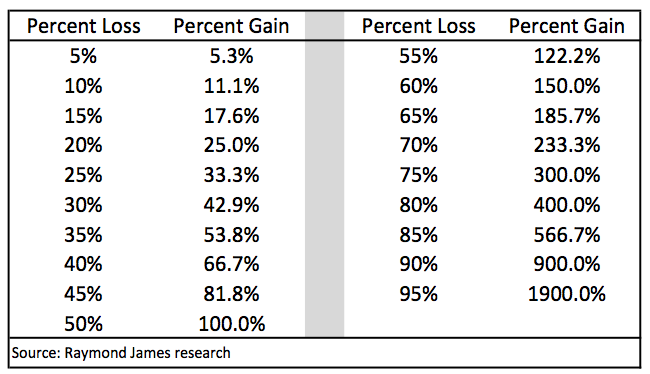
• Realize that a loss in the stock market is part of the investment process. The key is not letting it turn into a big one as this could devastate a portfolio.

• Said another way, “It’s not the ones that you sell that keep going up that matter. It’s the one that you don’t sell that keeps going down that does.

The table below depicts the percentage gain necessary to get back even, after a certain percentage loss.

• Your odds of success improve when you buy stocks when the technical pattern confirms the fundamental opinion.

• As many participants have come to realize from 1999 to 2010, during which the S&P 500 has made no upside progress, you can lose money even in the “best companies” if your timing is wrong. Yet, if the technical pattern dictates, you can make money on a short-term basis even in stocks that have a “mixed” fundamental opinion.

• To the best of your ability, try to keep your priorities in line. Don’t let the “greed factor” that Wall Street can generate outweigh other just as important areas of your life. Balance the physical, mental, spiritual, relational, and financial needs of life.

• Technical analysis is a windsock, not a crystal ball. It is a skill that improves with experience and study. Always be a student, there is always someone smarter than you!

Tuesday, October 19, 2010

Tuesday, July 27, 2010

10 Market Myths

1 "This is a good time to invest in the stock market."

Really? Ask your broker when he warned clients that it was a bad time to invest. October 2007? February 2000? A broken watch tells the right time twice a day, but that's no reason to wear one. Or as someone once said, asking a broker if this is a good time to invest in the stock market is like asking a barber if you need a haircut. "Certainly, sir -- step this way!"

2 "Stocks on average make you about 10% a year."

Stop right there. This is based on some past history -- stretching back to the 1800s -- and it's full of holes.

About three of those percentage points were only from inflation. The other 7% may not be reliable either. The data from the 19th century are suspect; the global picture from the 20th century is complex. Experts suggest 5% may be more typical. And stocks only produce average returns if you buy them at average valuations. If you buy them when they're expensive, you do a lot worse.

3 "Our economists are forecasting..."

Hold it. Ask your broker if the firm's economist predicted the most recent recession -- and if so, when.

The record for economic forecasts is not impressive. Even into 2008 many economists were still denying that a recession was on the way. The usual shtick is to predict "a slowdown, but not a recession." That way they have an escape clause, no matter what happens. Warren Buffett once said forecasters made fortune tellers look good.

4 "Investing in the stock market lets you participate in the growth of the economy."

Tell that to the Japanese. Since 1989 their economy has grown by more than a quarter, but the stock market is down more than three quarters. Or tell that to anyone who invested in Wall Street a decade ago. And such instances aren't as rare as you've been told. In 1969, the U.S. gross domestic product was about $1 trillion, and the Dow Jones Industrial Average was at about 1000. Thirteen years later, the U.S. economy had grown to $3.3 trillion. The Dow? About 1000.

5 "If you want to earn higher returns, you have to take more risk."

This must come as a surprise to Mr. Buffett, who prefers investing in boring companies and boring industries. Over the last quarter century, the FactSet Research utilities index has even outperformed the exciting, "risky" Nasdaq Composite index. The only way to earn higher returns is to buy stocks cheap in relation to their future cash flows. As for "risk," your broker probably thinks that's "volatility," which typically just means price ups and downs. But you and your Aunt Sally know that risk is really the possibility of losing principal.

6 "The market's really cheap right now. The P/E is only about 13."

The widely quoted price/earnings (PE) ratio, which compares share prices to annual after-tax earnings, can be misleading. That's because earnings are so volatile -- they're elevated in a boom, and depressed in a bust.

Ask your broker about other valuation metrics, like the dividend yield, which looks at the dividends you get for each dollar of investment; or the cyclically adjusted PE ratio, which compares share prices to earnings over the past 10 years; or "Tobin's q," which compares share prices to the actual replacement cost of company assets. No metric is perfect, but these three have good track records. Right now all three say the stock market's pretty expensive, not cheap.

7 "You can't time the market."

This hoary old chestnut keeps the clients fully invested. Certainly it's a fool's errand to try to catch the market's twists and turns. But that doesn't mean you have to suspend judgment about overall valuations.

If you invest in shares when they're cheap compared to cash flows and assets -- typically this happens when everyone else is gloomy -- you will usually do very well.

If you invest when shares are very expensive -- such as when everyone else is absurdly bullish -- you will probably do badly.

8 "We recommend a diversified portfolio of mutual funds."

If your broker means you should diversify across things like cash, bonds, stocks, alternative strategies, commodities and precious metals, then that's good advice.

But too many brokers mean mutual funds with different names and "styles" like large-cap value, small-cap growth, midcap blend, international small-cap value, and so on. These are marketing gimmicks. There is, for example, no such thing as "midcap blend." These funds are typically 100% invested all the time, and all in stocks. In this global economy even "international" offers less diversification than it did, because everything's getting tied together.

9 "This is a stock picker's market."

What? Every market seems to be defined as a "stock picker's market," yet for most people the lion's share of investment returns -- for good or ill -- has typically come from the asset classes (see No. 8, above) they've chosen rather than the individual investments. And even if this does turn out to be a stock picker's market, what makes you think your broker is the stock picker in question?

10 "Stocks outperform over the long term."

Define the long term? If you can be down for 10 or more years, exactly how much help is that? As John Maynard Keynes, the economist, once said: "In the long run we are all dead."

by Brett Arends

Thursday, May 27, 2010